Oil falls 3% to $110 as Iran talks stay alive and the US midterms near
A draft plan to reopen Hormuz is circulating, but Trump's pledge of no new strikes on Iran runs out after Tuesday's vote, leaving crude caught between a deal and a wider war.
The short version
Written with AI, checked by an editor- Brent fell 3% to $110 a barrel on Monday, after Iran's talks with Qatari mediators ended with a draft proposal circulating and a follow-up meeting possible.
- After Brent's 13.6% October gain, one analyst called Monday's fall a technical pullback rather than a verdict on the talks.
- The 3 November US midterms are the hinge: Trump's pledge of no new strikes lapses after the vote, with strikes reportedly possible from 4 November.
Oil eases as diplomacy survives a tense weekend
Oil prices fell on Monday morning. Brent crude, the global benchmark, was down 3% at $110 a barrel. WTI, the US benchmark, fell 3.4%. The drop followed a weekend in which talks to end the eight-month US-Israeli war on Iran stayed alive, even as Gulf officials said they were preparing for it to get worse.
Iranian negotiators spent a third straight day with Qatari mediators in Doha on Sunday, after more than 12 hours of talks in Tehran on Friday that were coordinated with Washington. The delegation left on Sunday. An official briefed on the talks said the departure was not caused by problems, that a draft proposal is circulating and that a follow-up meeting is possible.
Foreign Minister Abbas Araqchi said a "two-day proposal", which would reopen the Strait of Hormuz within two days of a deal with Washington, had reached no final conclusion. His spokesman set a hard condition: "no final agreement can be initiated, nor can the Strait of Hormuz be reopened or secured, unless the US naval blockade is brought to an end."
President Trump has ruled out new strikes before the 3 November midterms but not afterwards. MSNOW reported that Washington told Gulf allies to prepare for strikes as early as 4 November, a report that has not been confirmed. At the Manama Dialogue in Bahrain, UAE adviser Anwar Gargash said the region hopes for a breakthrough but is "braced for the worst."
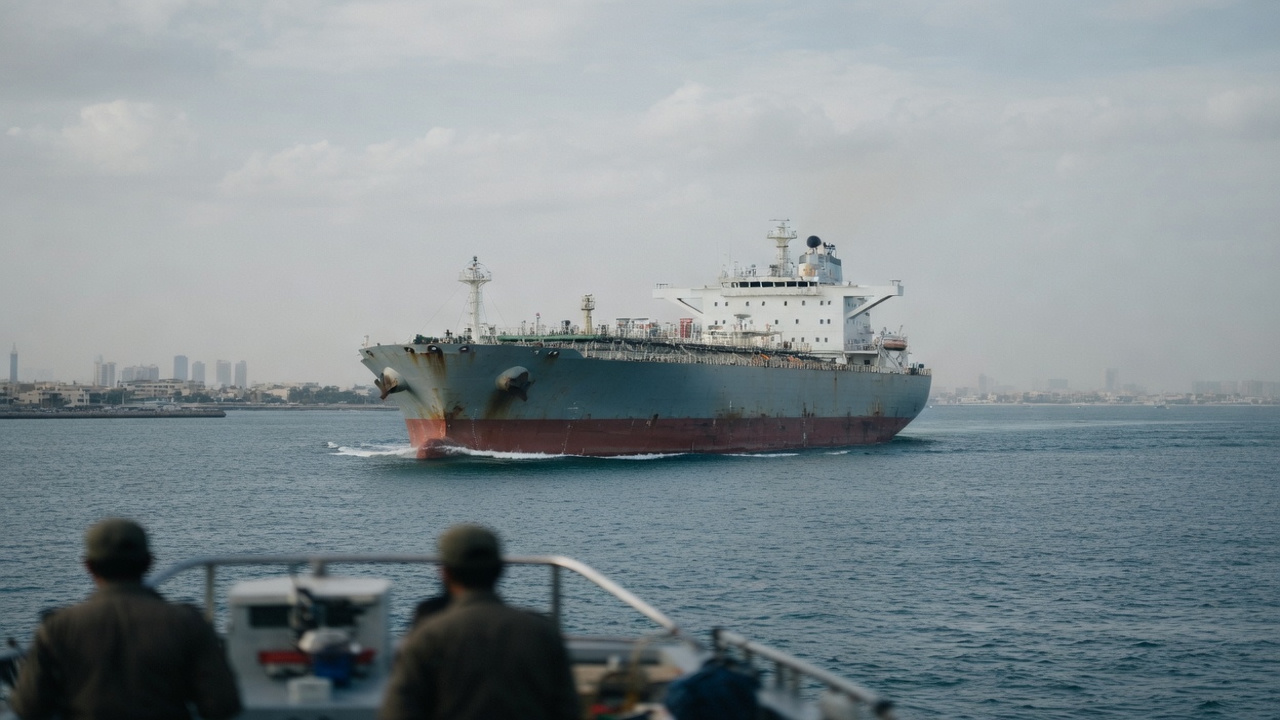
At sea, the danger is not new. The International Maritime Organization (IMO) has called Hormuz unsafe since April, and its chief repeated that on Sunday. What has changed is the pace of attacks: at least 29 ships were hit in October, the worst month of the war, against 20 in March. Nakilat said its tanker Al Mayeda was struck by "unidentified objects" on Friday evening, with no crew hurt.
Why oil fell while the strait got more dangerous
The fall looks more like a pause after a big run than a change of view. Brent gained 13.6% in October, its highest level since April, as attacks on ships mounted. After a rise that steep, some traders take profits, and Tim Waterer of KCM Trade called Monday's fall a technical pullback. Whether the talks played a part is unclear: the two-day reopening plan still hinges on the US lifting its blockade, which Washington has not agreed to.
The strait matters for the prices people pay because so little is getting through. The IMO chief says traffic is sharply below pre-war levels, with mines still in the only recognised shipping lane. Fewer tankers reaching buyers tends to keep crude expensive, and because crude is a large part of the cost of petrol, diesel and heating fuel, high oil prices feed through to what households spend on driving and keeping warm.
The midterm date matters because it is when Trump's restraint expires. Iran's supreme leader ordered the armed forces to meet any attack with a "geographically unrestricted response", and Iran has said it would hit US and Israeli targets in neighbouring countries. That is what Gulf states fear: a wider war on their own soil, not just on the water.
What this means for oil, energy shares and borrowing costs
Crude now trades on two opposing headlines, so swings in both directions are likely. If Washington engages with the draft and eases the blockade, Iran says the strait could reopen within two days, which would ease the supply fears behind October's gains. If strikes resume after the vote, Iran has threatened to hit targets across the region, which would deepen those fears. UBS expects Brent near $110 at year-end, while KCM Trade warns post-election rhetoric could push it toward $120. OPEC+ left December output targets unchanged on 1 November, so no extra supply is coming from producers to soften a shortage.
Oil companies' revenue rises and falls with crude, so US energy shares carry the same two-way risk: a deal would likely weigh on them, while renewed strikes would tend to lift them.
Brent and WTI are caught between a possible two-day Hormuz reopening deal and the risk of new US strikes once the midterm pledge lapses, so daily swings are likely to widen.
Wrong ifA clear US decision either accepting the draft and easing the blockade or launching strikes would settle direction and reduce two-way swings.
WTI is priced off US supply further from the Gulf, so it tends to follow Brent's moves on Hormuz news but with a smaller war premium.
Wrong ifA durable reopening of Hormuz with traffic recovering toward pre-war levels would remove the two-sided risk.
Oil producers' revenue rises and falls with crude, so the shares carry the same deal-or-strike risk.
Wrong ifCompany-specific or broad equity market forces outweighing the oil price.
As general reasoning rather than an observed move: if Brent holds near $110, worries about inflation could lead investors to ask for slightly higher yields on long-term US debt.
Wrong ifA Hormuz deal that pulls crude sharply lower, or weaker US growth data that dominates bond pricing.
The case that the market is right to stay calm
The calm reading has support. Secretary of State Marco Rubio said "talks have actually never stopped", Axios reported that Trump was eager to let negotiations play out despite Netanyahu's push for strikes, and the US has not hit Iran since 1 September. Brent rose only about 0.8% over the past week, after a gain of about 15% on the month, which suggests traders were consolidating the rally rather than adding new risk.
The limits are real, though. Trump has so far rejected Iran's core demands on the blockade and frozen assets, and the IMO says the only recognised route through the strait is not clear of mines, so even a deal would not make passage safe at once.
The dates that decide the next move
The midterms on 3 November and the reported 4 November window come first. After that, watch for a date for the next round of talks, any US answer on the blockade, and whether weekly ship attacks pick up again. In our reading, a Brent move back above Friday's $113.43 settlement would show traders leaning toward escalation. OPEC+ meets on 29 November to set 2027 output policy.
- 2026-11-03US midterm elections, after which Trump's pledge of no new strikes on Iran lapses: The end of the pledge opens the door to renewed military action that would threaten Gulf supply.
- 2026-11-04Earliest date for possible US strikes reportedly flagged to Gulf allies (unconfirmed): Strikes would likely reverse Monday's oil fall; no action would support the diplomatic reading.
- Follow-up round of Qatari-mediated talks on the draft proposal: A US response on the blockade would show whether the two-day reopening plan is viable.
- 2026-11-29OPEC+ meeting on 2027 output policy: Any extra supply would cushion prices if Hormuz stays restricted.
Researched and drafted with AI assistance from the sources below, checked against our editorial standards, and reviewed by a named editor. How we use AI → Found an error? Report it.
MacroInsight provides market commentary for information only. It is not investment advice or a recommendation to buy or sell any security.