AI selloff gives Nasdaq its worst week since 2020, and Monday's futures bounce is partial
Futures won back only part of last week's losses while Treasury yields rose and Korean stocks kept falling, a sign the pressures behind the selloff have not lifted.
The short version
Written with AI, checked by an editor- The Nasdaq Composite fell 10% in the week to November 20, its worst since March 2020, as an AI-led selloff spread to Asia and Europe.
- Strategists say selling spread beyond tech as investors sought cash, while rising bond yields and an expected December Fed hike gave stocks no cushion.
- Monday's futures rebound is partial; Wednesday's PCE inflation data, which bears on a December Fed hike, and news on Nvidia's accounting review will test it.
A long slide in AI stocks turned into a rout
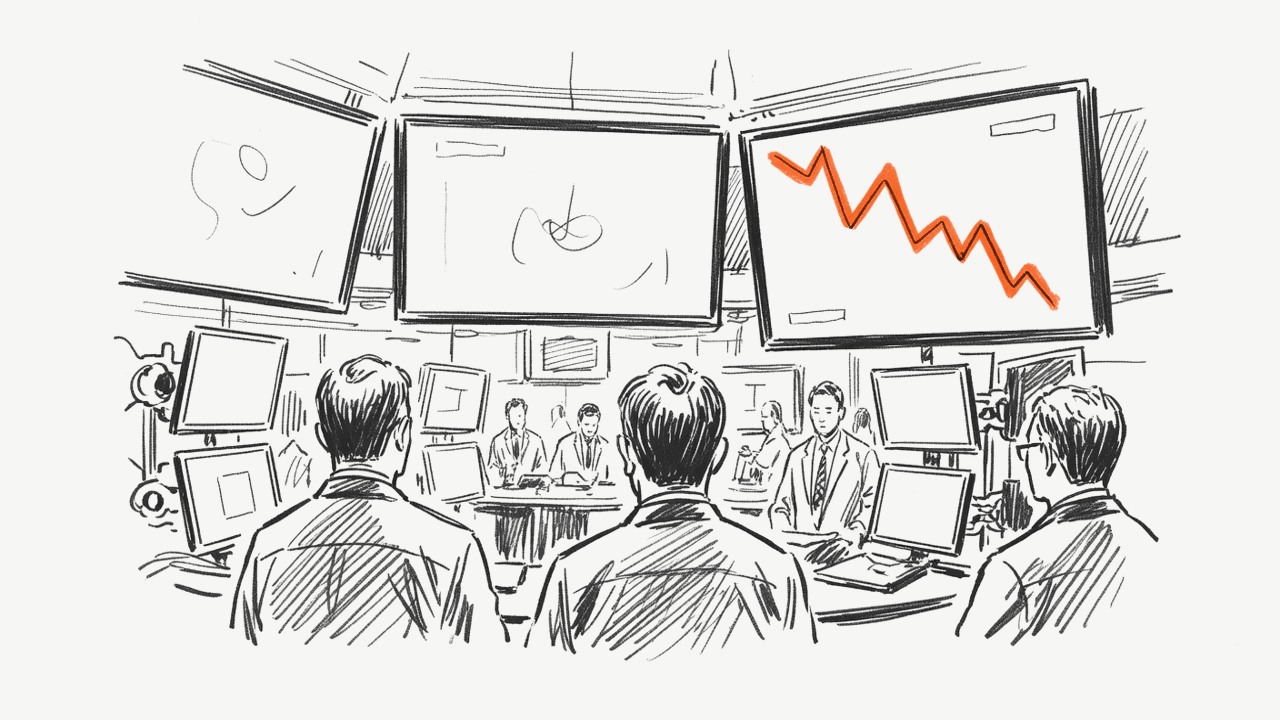
Stocks tied to artificial intelligence led a week of heavy selling to Friday, November 20. The Nasdaq Composite fell 10%, its biggest weekly loss since March 2020, and is now down for the year. MSCI's index of global shares dropped 8.1%, also its largest weekly fall since early 2020. The broader S&P 500 fared slightly less badly: it lost 8.6%, its worst week since April 2025, and is now in a correction, more than 10% below its October 6 record. The Dow fell 8%.
Friday was the sharpest day. Nvidia fell about 14% after a Reuters report that regulators were examining accounting irregularities at the company, taking its loss for the week to 23%. Anthropic, a day after its stock market debut, fell 9% and ended about 23% below the $115.10 peak it touched on its first day. Abroad, Taiwan's Taiex lost 17.5% for the week, its steepest five-day fall since 1990. South Korea's Kospi lost 7.9%, Japan's Nikkei 7.7% and Europe's STOXX 600 nearly 6%.
This was an acceleration, not a new shock. Chipmakers were already 35% below their June peak, Taiwan's market was nearly 28% off its October 6 high, and Nvidia had dropped more than 25% since the scandal around former chief executive Jensen Huang broke earlier this month.
On Monday, US futures recovered part of the ground: by 08:51 GMT Nasdaq 100 futures were up 3.3%, and Nvidia rose nearly 9% before the opening bell. European shares edged higher. The Kospi kept falling, even as Asian governments stepped in: Taiwan restricted short selling, China cut its margin requirement, and South Korea prepared a stabilisation fund.
Why a tech selloff reaches ordinary savings
Deutsche Bank strategist Jim Reid argues the selling stopped being about tech and became a search for cash. "This was no longer simply a tech selloff," he said, describing investors around the world seeking liquidity. Gold, which normally holds up in turmoil, had fallen to a 14-month low before rebounding 3% on Monday, and hedge funds lost more than 3% in the week, their worst since April 2025, according to a JPMorgan client note. For savers, that means the usual safe corners offered less shelter than expected.
For anyone with an index fund or a pension, the year's gains have largely gone. Big technology companies make up the largest share of the S&P 500, so when they fall the whole index follows. By Friday the S&P 500 was up less than 1% for the year, after reaching a record only in October.
Interest rates are offering no relief. The Federal Reserve raised its target range to 3.75%-4.00% in September, and markets put the chance of another quarter-point rise in December above 97%. The US 10-year Treasury yield rose 5 basis points (hundredths of a percentage point) to 4.96% on Monday even as stocks bounced. Higher yields make distant future profits worth less today, which hurts richly valued AI companies most, and they tend to keep borrowing costs elevated.
Several worries arrived at once: doubts that heavy spending on AI data centres will pay off, the leadership crisis at Nvidia, Anthropic's rocky debut, Democrats sweeping the US midterms, and the prospect of tighter Fed policy.
What the bounce does and does not fix
Expect large swings in US stocks in both directions. Fear is high: the VIX, which measures expected volatility, rose above 40 last week for the first time since April 2025. Even after Monday's gains, Nasdaq 100 futures were about 18% below their 52-week high and S&P 500 futures roughly 10% below their peak. If the rebound holds through the US trading day, it would ease the forced selling; if it fades, last week's lows come back into view.
Chip stocks remain the centre of the storm. Nvidia, AMD and Micron all rose sharply before Monday's open, but nothing has been settled about the accounting review or who will lead Nvidia. Until that clears, Nvidia's swings are likely to spill over to Taiwan Semiconductor, which makes its chips, and to other AI chipmakers.
Asian support measures have a mixed record. Taiwan's stabilisation fund first stepped in on November 6; shares rallied, then fell below where they started. Reports on Monday had the Taiex both down 0.93% and up 2.2%, while the Kospi is now 48.1% below its June high.
Bond yields hold the key for the rest of the market, because higher yields lower the value of future profits. Hotter inflation would raise the odds of a Fed hike and push yields up. October headline PCE inflation is forecast at 3.8%, up from 3.6% in September; a reading at or above that could squeeze shares again.
Volatility is already elevated, with the VIX above 40 and the Nasdaq down 10% in a week, so large daily swings in both directions are likely to persist.
Wrong ifThe VIX falls back below 40 and US stocks post steady gains over several sessions.
A December Fed hike priced at above 97% and inflation forecast to rise in October keep upward pressure on long-term yields.
Wrong ifOctober PCE inflation comes in below forecasts, cutting the odds of a December hike.
An unresolved accounting review and leadership vacuum leave the stock exposed to each new report.
Wrong ifRegulators close the review or the company names a credible new chief executive.
Short-selling curbs and state buying support prices, but an earlier intervention in November faded.
Wrong ifA sustained rebound in US AI stocks that lifts Taiwan above pre-intervention levels.
The case that the worst may be over
The case for a turn is real. Chip stocks led Monday's rebound, with Nvidia, AMD and Micron up sharply before the open, and governments in Taipei, Beijing and Seoul are buying shares, cutting margin requirements or restricting short sales. Even after the rout, the S&P 500 was still up for the year, so most long-term savers are roughly where they started in January rather than deep underwater. Against that, the forces behind the selling remain: markets price a December hike at above 97%, the questions over Nvidia's accounting and leadership are unanswered, and Taiwan's earlier rescue in November faded.
A short, data-heavy holiday week
The flash PMI survey lands on Monday, November 23, and consumer confidence on Tuesday. Wednesday, November 25, brings October PCE inflation, revised third-quarter GDP and the Fed's Beige Book; headline inflation above the 3.8% forecast, or core above 3.2%, would firm up a December hike. Markets close for Thanksgiving on November 26. Earnings from Dell, HPE and Analog Devices will test demand for AI hardware. The Fed decides on December 9.
- 2026-11-25US October PCE and core PCE inflation, Q3 GDP second estimate, Fed Beige Book: Inflation above the 3.8% and 3.2% forecasts would push yields higher and cement a December hike.
- Week of 2026-11-23Earnings from Dell, HPE and Analog Devices: A read on whether demand for AI hardware is holding up.
- 2026-11-24Conference Board consumer confidence: Shows whether the market rout is denting household sentiment.
- 2026-12-09FOMC decision: Markets put the odds of a quarter-point hike above 97%.
Researched and drafted with AI assistance from the sources below, checked against our editorial standards, and reviewed by a named editor. How we use AI → Found an error? Report it.
MacroInsight provides market commentary for information only. It is not investment advice or a recommendation to buy or sell any security.